
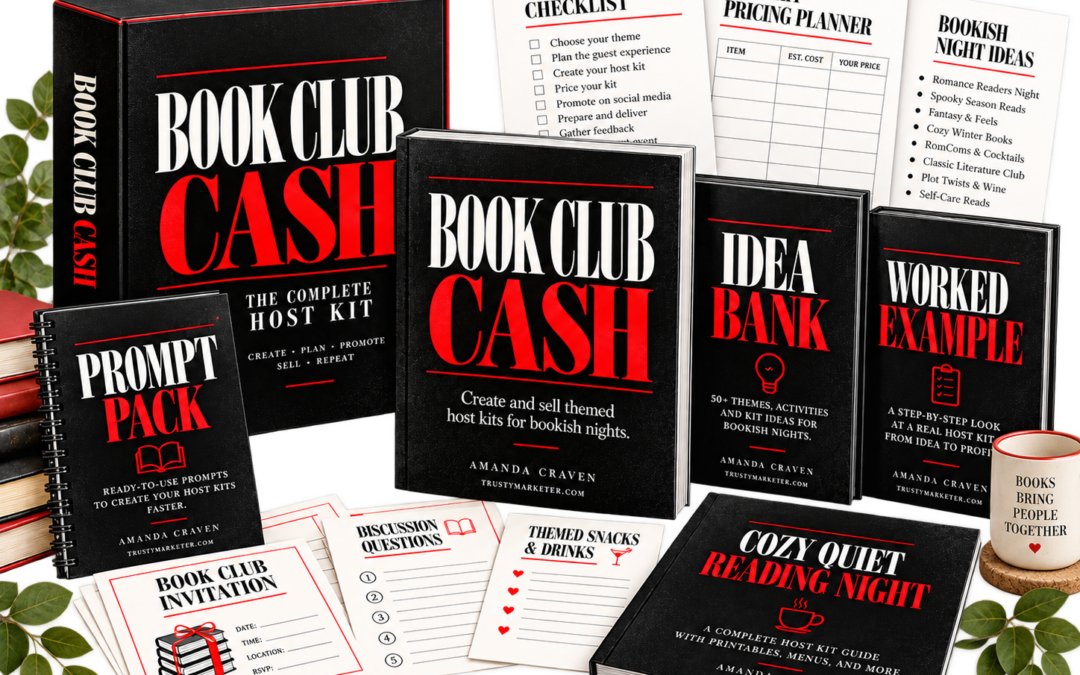
I just launched my latest product, Book Club Cash.
As I write this, it’s already passed 100 sales, which is lovely!
But I’ve been thinking about something that goes well beyond launch week.
One thing I’ve learned from creating and selling products over the years is that you can’t always judge their success by what happens in the first few days.
Some sell brilliantly from the moment they’re launched. Others start slowly, then go on to generate sales for months or even years.
And sometimes a product you created with one particular market in mind turns out to have possibilities you hadn’t even considered.
That’s why I think it’s a mistake to judge a product solely on its launch results. What you’ve created is something you can keep selling, adapting and introducing to new audiences long after the initial excitement has died down.
As an author, I’m very familiar with this. A book doesn’t stop being an asset when publication week is over. It can find new readers years later. It might sell in another language, become an audiobook or even find its way onto a screen.
And the same principle applies to digital products.
Take Book Club Cash. I created it because I love books, I know how much people enjoy getting together around them, and I’ve made money from book-related experiences myself.
But here’s the thing I love – that one product could have several different commercial lives.
I can sell it as a standalone product. I can introduce it to a completely different audience. I can include it in a future package. I can develop complementary products around it.
And because I’ve created the underlying materials, I have something I can continue using.
The launch is only the beginning of what that asset might earn.
So how do you get more from something you’ve already created?
Here’s an exercise I’d encourage you to try this week.
Choose one product, piece of content or creative project you’ve already finished.
Then ask yourself these five questions:
1. Who ELSE could buy this?
Perhaps you’ve created a resource for entrepreneurs, but teachers, community organisers or hobbyists could benefit from a version of it.
You don’t necessarily need another product. You might need another audience.
2. What other form could it take?
Could your guide become a workshop? Could your templates become a printable kit? Could your research become an interactive tool?
Sometimes changing the format changes how customers perceive its value.
And with the AI tools available now, you may be able to experiment with a new format without starting again.
3. What would someone naturally want next?
If your product helps someone plan an event, perhaps they’ll also want invitations or promotional materials.
If it helps someone create something, perhaps they’ll need help finding buyers.
A good product often reveals the next problem worth solving.
4. Could it work better as part of something bigger?
Perhaps you’ve got three products that aren’t doing much individually but would make a terrific package together.
Or an existing product could become an upgrade to something else you sell.
You could even license some of your material for other people to use commercially, provided you own the necessary rights.
5. Could you sell it somewhere different?
A product that attracts little attention on one marketplace might appeal to a completely different audience elsewhere.
Different buyers have different priorities. And something that feels familiar in one market can be a genuine discovery in another.
The important thing is to test these possibilities rather than assume they’ll work.
Six free resources to help you explore the possibilities
I’ve found some resources that might inspire you to look at your existing work a little differently.
1. The Creative Penn – Book Marketing Tips for Fiction and Non-Fiction Authors
Joanna Penn explores marketing principles that continue to work beyond a book’s initial publication.
You don’t have to be an author to learn from this. Think about how you could keep introducing an existing product to people who haven’t encountered it yet.
2. UK Intellectual Property Office – Using Your Intellectual Property Rights
https://www.gov.uk/government/publications/using-your-intellectual-property-rights-steps-to-consider
This is a particularly good one if you’ve created something original.
The guide explains different ways to benefit from intellectual property you own, including licensing it to other businesses.
Perhaps you’ve been thinking of your creations purely as products to sell directly, when they could have other commercial applications.
3. Etsy – How to Spot Trends and Keywords With Marketplace Insights
https://www.etsy.com/seller-handbook/article/1404564905677
Etsy’s Marketplace Insights tool uses real search data to show what buyers are looking for.
Before creating something entirely new, why not investigate whether something you’ve already made could appeal to another group of customers?
The article explains how to use the tool and interpret the information.
4. Shopify – The Power of Product Bundles
https://help.shopify.com/en/manual/products/bundles
Two or three existing products might be more attractive together than they are separately.
Shopify explains different ways to package related products into collections that offer customers additional value.
You don’t need to use Shopify to apply the principle.
5. Mailchimp – Smarter Ecommerce Customer Segmentation
https://mailchimp.com/resources/ecommerce-customer-segmentation
Not every product will appeal to every person on your list.
This guide explores how to identify different customer groups and communicate with them more effectively.
Perhaps an older product doesn’t need replacing. Perhaps it needs to be shown to the right people.
6. Shopify – 11 Best Digital Products to Sell Online in 2026
https://www.shopify.com/blog/digital-products
A good source of inspiration for reimagining material you’ve already created.
Could your written content become a set of templates? Could a process you’ve developed become a tool? Could your expertise become a resource that customers use repeatedly?
You may discover that you’ve already done much of the hard work.
And this week’s TED Talk…
This week’s TED Talk: Success, Failure and the Drive to Keep Creating — Elizabeth Gilbert
I love this talk from bestselling author Elizabeth Gilbert, who explores something I think every creator needs to understand: success and failure are both temporary, and neither should determine what we do next.
It’s a particularly good reminder when we’re tempted to judge something we’ve created entirely by its initial reception.
One final thought…
I think one of the biggest mistakes we make as creators is constantly looking for the next idea when we may already be sitting on something with far more potential than we’ve realised.
Of course, not every product deserves endless attention. Sometimes the sensible thing is to move on.
But sometimes the smartest move is to look at something you’ve already made and ask:
What else could this become?
That’s certainly what I’m doing with Book Club Cash.
I’ve created something I believe in, and I’m excited about all the different ways I can use it in the months and years ahead.
And if you’re a book lover, perhaps this is your opportunity to create an asset of your own.
Book Club Cash shows you how to create and sell bookish party kits that readers can enjoy, whether that’s for a book club gathering, a themed celebration or a cosy reading night.
And here’s the lovely thing.
You only have to create a kit once. Then you can offer it for sale again and again.
That’s exactly the sort of asset I’ve been talking about today.
See how Book Club Cash can help you create something worth selling again and again